Data Migration during Change of Software: Part – 1

Data Migration - Troyee system

5 Things to Check before Switching from "One-size-fits-all" or "Unmodifiable" Software

When a business outgrows "off-the-shelf" software, the transition is a high-stakes move. To ensure your next choice provides long-term ROI rather than a new set of limitations, here are 5 professional checkpoints to evaluate before making the switch.

1. Data Portability & Historical Continuity

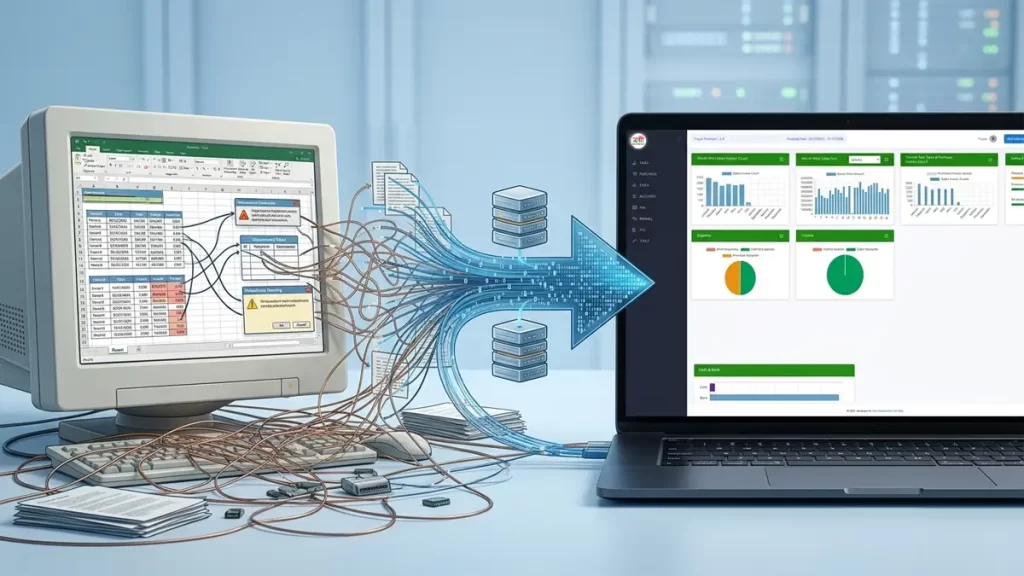
Many “one-size-fits-all” systems make it difficult to extract your data in a clean, usable format. Before switching, verify if the new provider has a proven methodology for Data Migration.

■ The Check: Can they migrate your last 3–5 years of ledger balances and inventory closing without corruption? A professional house should offer a seamless “Data Conversion” service so you don’t start from zero.

2. The "Hard-Coded" vs. "Custom-Add-on" Architecture

Standard software is often “hard-coded,” meaning you cannot change a report format or a calculation logic without waiting for a global update.

■ The Check: Does the software allow for Custom Add-ons at the entry or report level? You need a system that offers a stable “Core” while allowing unique “Extensions” specifically designed for your specific business workflow.

3. Localization & Compliance Depth

International or generic software often treats local taxes (like NBR VAT requirements in Bangladesh) as an afterthought or a “patch.”

■ The Check: Is the software natively designed for local compliance? For example, check if it generates NBR-mandated forms (6.3, 9.1) automatically from daily transactions. If you have to use a separate “bridge” software for VAT, you are doubling your risk of error.

4. Implementation Speed vs. Remote Support

A common trap is buying a sophisticated system that takes a year to implement because the support is purely remote or handled by third-party agents who don’t understand your domain.

■ The Check: Does the provider offer On-site Implementation and a dedicated domain expert? Speed of implementation is the true measure of a software house’s capability. If they can’t map your business logic on-site, the project will likely stall.

5. Scalability Beyond the "Starter" Phase

Your software should be a “forever home” for your data. Many systems work fine for small volumes but crash or slow down as your transaction count reaches the hundreds of thousands.

■ The Check: Does the product offer a clear upgrade path (e.g., from Standard to Enterprise or Premium editions)? Ensure the architecture (SQL/Web-based) is robust enough to handle high-concurrency and multiple branch locations without lag.

“At Troyee, we don't just sell software; we provide the answers to these 5 critical checks through our Simple, Reliable, and Flexible architecture and our Unique Implementation Methodology."